
Ligament Surgery
Ligament Surgery
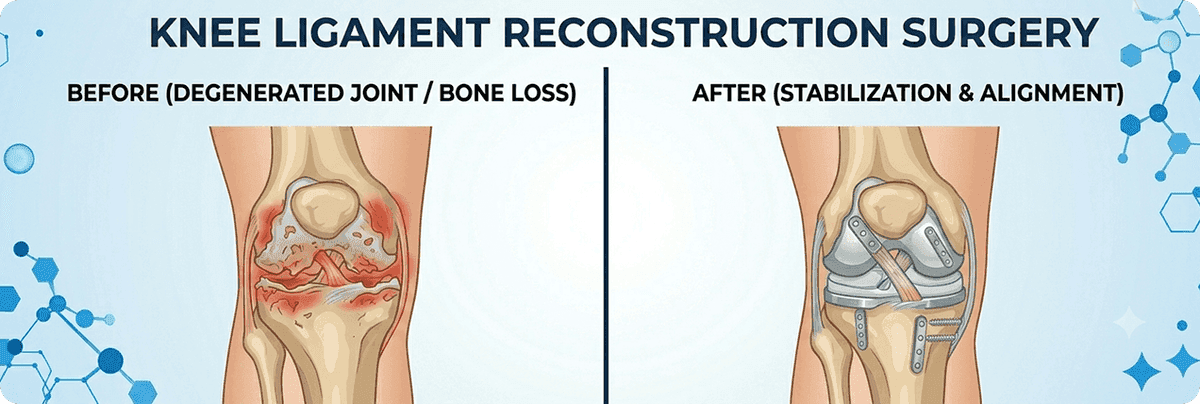
Ligament surgery is a procedure performed to repair or reconstruct a torn or damaged ligament. Ligaments are strong, fibrous tissues that connect bones to each other and provide stability to joints. When a ligament is torn, it can cause pain, instability, and difficulty moving the joint.
Types of ligament surgery
The type of ligament surgery performed will depend on the specific ligament involved, the severity of the tear, and the patient's individual condition. Here are some common approaches:
Reasons for ligament surgery
Ligament surgery is not always necessary for a torn ligament. In many cases, non-surgical treatments like rest, icing, compression, and physical therapy can promote healing. However, surgery may be considered if:
Point: The tear is severe and involves a complete rupture of the ligament.
Point: The tear is causing significant instability in the joint, leading to problems with walking, running, or other activities.
Point: Non-surgical treatments haven't been successful in alleviating pain and improving function.
Arthroscopic surgery: This is a minimally invasive procedure that uses a small camera and specialized instruments inserted through tiny incisions to visualize the ligament and perform repairs. Arthroscopy is often used for ligament tears in the knee, shoulder, and ankle.
Open surgery: In some cases, a larger incision may be necessary to access and repair the ligament. This is typically done for more complex tears or when arthroscopic techniques are not suitable.
Ligament repair: If possible, the surgeon will attempt to reattach the torn ends of the ligament using sutures or anchors.
Ligament reconstruction: If the ligament is too damaged to be repaired, the surgeon may use a graft to reconstruct it. The graft can be tissue taken from another part of the patient's body (autograft) or from a donor (allograft).
Recovery from ligament surgery
The recovery time from ligament surgery can vary depending on the type of procedure performed, the severity of the injury, and the patient's individual healing process. In general, ligament surgery often involves immobilization of the joint for a period of time using a cast, brace, or splint, followed by physical therapy to regain strength, flexibility, and range of motion. It can take several weeks or months to return to normal activities.
Clinical Monitoring: Immediate post-operative care with constant tracking of vital stats.
Rehabilitation: Tailored physical therapies to promote systemic healing.
Risks and complications of ligament surgery
As with any surgery, there are risks and complications associated with ligament surgery, such as:
Infection
Bleeding
Blood clots
Nerve damage
Stiffness in the joint
Failure of the repair or reconstruction
If you suspect you have a torn ligament, it's important to see a doctor for proper diagnosis and treatment plan. Our Specialist can advise you on the best course of action, whether it's non-surgical management or surgery, to get you back to your activities.
Our clinical coordinators are available to answer all questions regarding your diagnosis, recovery pathways, and clinical pricing structures in India.

Meet Our Other Related Doctors
Our Trusted Network of India's Top Hospitals
We partner with top-tier hospitals across India, ensuring world-class infrastructure, expert specialists, and internationally recognized standards of care - so you receive safe, reliable, and high-quality treatment at every step.
Real Stories of Care and Recovery
Hear from patients who trusted us with their care and experienced successful treatment journeys with confidence and support.

From the very first moment, he were proactive and truly attentive. He immediately reached out to me personally, called me to understand my situation in detail, and took the time to clarify every single question I had. I ...
98%
Of Patients Recommended NoorMedicare